Best Graphics Buying Guide — Black Friday Deals 2026
A graphics-card shortlist is most useful when it starts with the system and tasks you already have in mind. The three options here make different choices around memory, listed features, power requirements and display connections, so a headline alone will not identify the right fit. The ASRock RX 9070 Challenger is the Best Overall editorial pick, the RX 7600 Challenger Pro is Best Budget, and the ASUS Dual RTX 5060 is Best for DLSS 4 Upscaling. These labels describe choices within this guide, not measured superiority. During Black Friday, compare the exact model and variant on offer, then check its specifications against your case, power supply and displays before deciding.
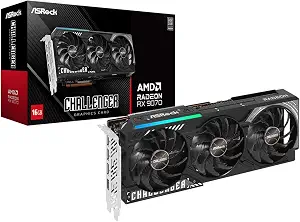
The Best Overall label goes to this card because its listed configuration combines 16GB of GDDR6 on a 256-Bit Bus with the RX 9070 GPU’s RDNA 4 Architecture, 56 CUs and 3584 stream processors. Those details make it a natural candidate for shoppers who want to consider a higher-memory option among these three listings. They are specifications, not a promise of frame rates or suitability for a particular game. Think about the programs and displays you intend to use, and check their requirements separately before making the card the center of a build.
The clock figures are a boost clock up to 2520 MHz and a game clock of 2070 MHz. Its high-speed memory is listed at 20 Gbps, and the interface is PCIe 5.0. These are useful points to compare when narrowing a shortlist, but they do not predict the experience in a specific system. During Black Friday, make sure the offer is for this RX 9070 Challenger 16GB OC model rather than another card with a similar family name. Confirm the precise variant in the listing before weighing its offer against the other options.
Plan the physical and electrical fit before committing: this is a 2.5-slot card measuring 290x123x51mm, uses two 8-pin power connectors, and has a recommended 700W PSU. Check the case’s available card space and the power supply’s connections and capacity independently. The Best Overall choice is most compelling for a shopper whose build can accommodate those stated requirements and who values the listed 16GB memory configuration. If the case, supply or intended workload makes another configuration a closer match, the label should not override that practical fit. Revisit those details when comparing Black Friday listings.
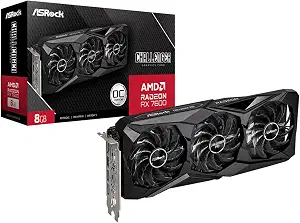
ASRock Radeon RX 7600 Challenger Pro 8GB OC (ASIN B0G6FCDZMK)
The Best Budget label identifies this RX 7600 Challenger Pro as the guide’s value-oriented configuration, not as a claim about its current price. It has 8GB of GDDR6 memory on a 128-bit interface running at 18 Gbps, with a max boost clock of up to 2695 MHz and a game clock of 2280 MHz. Shoppers considering a graphics card for a more focused build can use those details as a starting point, then check the requirements of the games or applications they care about. The specifications alone do not establish performance or value for an individual buyer.
One specific convenience is its 0dB Silent Cooling feature, which stops the fans completely under low temperatures. Treat that as a named cooling behavior rather than a claim about noise in every situation. The card provides three DisplayPort 1.4a with DSC and one HDMI 2.1 port, details worth checking against the monitors and cables you plan to connect. For Black Friday, verify that the exact listing is for the Challenger Pro 8GB OC version; a similar product name may not identify the same card or specifications.
The card uses a PCI Express 4.0 x8 interface and is compatible with PCIe 4.0 and 3.0 motherboards. Its power requirement is a single 8-pin connector with a recommended 550W power supply. Physical clearance matters too: it is a 2.5-slot card measuring 303 mm (L) x 131 mm (W) x 45 mm (H). Those dimensions are worth comparing with the space in your case rather than assuming a card will fit because the slot count seems familiar. The Best Budget label can help set a shortlist, while your own fit checks and the exact Black Friday offer should guide the final choice.
Key specs
Memory
8GB of GDDR6 memory on a 128‑bit interface running at 18 Gbps
Clock speeds
a max boost clock of up to 2695 MHz, a game clock of 2280 MHz
Power requirements
requires a single 8‑pin power connector and a recommended 550W power supply
Dimensions
2.5‑slot card measuring 303 mm (L) x 131 mm (W) x 45 mm (H)
Cooling
0dB Silent Cooling stops fans completely under low temperatures
Display connections
Includes three DisplayPort 1.4a with DSC and one HDMI 2.1 port
Interface
PCI Express 4.0 x8 interface (compatible with PCIe 4.0 and 3.0 motherboards)
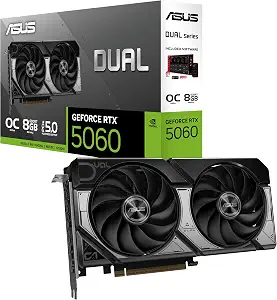
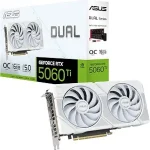
ASUS Dual NVIDIA GeForce RTX 5060 8GB GDDR7 OC Edition
The ASUS Dual NVIDIA GeForce RTX 5060 8GB GDDR7 OC Edition earns the Best for DLSS 4 Upscaling label because DLSS 4 is explicitly listed. That makes it the most direct option in this group for shoppers who specifically want to consider that feature. The listing also specifies 8GB of GDDR7 memory and a PCIe 5.0 interface. A named feature is a point for comparison, not a guarantee of results in every game or application; check whether the software you intend to use supports the feature and whether it suits your plans.
Its clock speeds are listed as OC mode: 2565 MHz (OC mode)/ 2535 MHz (Default mode). For display connections, it has Native DisplayPort 2.1b x3 and Native HDMI 2.1b. These details can help narrow a choice if the card’s listed outputs match the displays you use, but confirm the requirements of the complete setup rather than relying on the port names alone. During Black Friday, check that the offer is for this ASUS Dual RTX 5060 OC Edition and that the listing identifies the same memory and output configuration.
The design is 2.5-Slot, with an Axial-tech fan design. Its smaller fan hub facilitates longer blades, while a barrier ring increases downward air pressure. Those are the supplied design details; they should not be stretched into claims about temperatures, noise or performance in a particular case. The Best for DLSS 4 Upscaling label is most useful to someone who already values that listed feature and can confirm the rest of the card’s fit for their system. Compare the exact Black Friday variant with the other cards on the priorities that matter to you, not on the label alone.
Key specs
Memory
8GB GDDR7
Interface
PCIe 5.0
Upscaling
DLSS 4
Video outputs
Native DisplayPort 2.1b x3, Native HDMI 2.1b
Design
2.5-Slot Design
Fan design
Axial-tech fan design features a smaller fan hub that facilitates longer blades and a barrier ring that increases downward air pressure
Before comparing cards, name the work you expect the graphics hardware to support. A gaming-focused buyer may begin with the games and display setup they have in mind; someone choosing a card for creative applications should first check those applications’ requirements. The supplied product details do not establish results in any particular workload, so avoid treating a clock figure, memory type or editorial label as a performance forecast. Instead, use the specifications to identify configurations worth investigating and verify what your own software requires.
Memory is one useful separator here: the RX 9070 listing specifies 16GB of GDDR6, while the RX 7600 and RTX 5060 list 8GB, with GDDR6 and GDDR7 respectively. Capacity and memory type are distinct details, and neither on its own settles a buying decision. The RX 9070 also names RDNA 4 Architecture, 56 CUs and 3584 stream processors; the ASUS lists DLSS 4. A Black Friday comparison should connect these named details to your priorities instead of assuming that one specification answers every question.
Write down what matters most before browsing offers: a particular named feature, memory configuration, an available connection, or the card’s power and size requirements. That list makes it easier to ignore a tempting headline when the configuration is not right for your intended use. If you cannot identify a need for one of the listed distinctions, keep it as a preference rather than treating it as essential. Then check the exact Black Friday offer against the card’s full model identity and your system requirements.
Black Friday listings: confirm the exact card
Seasonal listings can make family names and product titles feel interchangeable, but small differences in a model name may point to a different configuration. For each Black Friday offer, check the complete name and variant shown on the product page. In this guide, that means distinguishing the RX 9070 Challenger 16GB OC, RX 7600 Challenger Pro 8GB OC and ASUS Dual RTX 5060 8GB GDDR7 OC Edition. Match the title to the card you intended to compare before moving on to its specifications.
Next, check the details that can identify the configuration: memory type and capacity, interface, named feature and display connections. For example, the RX 7600 listing specifies PCI Express 4.0 x8, while the other two list PCIe 5.0. The ASUS names DLSS 4 and the RX 9070 lists RDNA 4 Architecture. Those facts help you distinguish the cards; they do not establish that an offer is a bargain or that a product will suit every system.
Do not infer a discount, stock status or special promotion from seasonal wording. No price or promotion details are provided here, so evaluate the actual offer shown to you and compare the exact variant rather than an assumed deal. If a listing leaves a key detail unclear, pause and resolve that uncertainty before purchase. A Black Friday headline can help you find an offer, but the model identity and specifications are what let you check whether it matches your shortlist.
Measure the case and check the power separately
A graphics card needs room in the case, and its power requirements need their own check. Do not use a slot count as a substitute for comparing the card’s dimensions with the space available in your particular case. The RX 9070 is a 2.5-slot card measuring 290x123x51mm; the RX 7600 is a 2.5-slot card measuring 303 mm (L) x 131 mm (W) x 45 mm (H); the ASUS design is listed as 2.5-Slot. The ASUS dimensions are not supplied here, so look them up in the exact listing or product information before making a fit decision.
Power details differ as well. The RX 9070 calls for two 8-pin power connectors and a recommended 700W PSU. The RX 7600 specifies a single 8-pin connector and a recommended 550W power supply. No power requirements are included for the ASUS in these product facts, so do not assume them; verify them for the exact card. Check the connectors available from your power supply as well as its capacity, and consult your system documentation if you are unsure.
This is especially important when a Black Friday offer creates pressure to decide quickly. A card that appears attractive on paper is not a practical choice if its fit or power needs do not align with your build. Compare the card’s stated dimensions with the case and check the supply requirements independently. If a specification is missing from the information in front of you, treat it as something to confirm—not as permission to guess. A short compatibility check can make the seasonal comparison more grounded.
Plan display connections around the setup you have
List the displays you intend to use and identify the connection types they need before choosing a card. The RX 7600 listing provides three DisplayPort 1.4a with DSC and one HDMI 2.1 port. The ASUS lists Native DisplayPort 2.1b x3 and Native HDMI 2.1b. No video-output details are supplied for the RX 9070 in these product facts, so check the exact listing or other product information if its connections are important to your decision. Do not assume an output based on the brand or product family.
Port names are only part of the check. Confirm that the outputs available on the selected card line up with the displays and cables in your setup, and review any connection requirements relevant to your intended arrangement. The supplied facts identify interfaces but do not describe every display configuration or guarantee compatibility with a particular monitor. If you plan to change displays later, consider that plan as well, while verifying the requirements of the specific hardware involved.
Use Black Friday browsing to compare actual configurations, not just attractive feature summaries. A card with a named output is useful only if it addresses a need you have, and a missing output detail should prompt a check rather than an assumption. Make a brief list of the connections you need and the ones each exact listing states. That turns a broad category search into a concrete check and can keep a seasonal offer from distracting you from your display setup.
Separate useful features from promises
Specifications describe what a listing names; they do not automatically predict how a card will behave in every system. The RX 7600’s 0dB Silent Cooling is specified to stop the fans completely under low temperatures. That qualification matters: it is not a statement that the fans always stop or that the card is silent in all conditions. Similarly, the ASUS listing describes its Axial-tech fan design, including a smaller fan hub that facilitates longer blades and a barrier ring that increases downward air pressure. Keep the description within those stated terms.
Clock figures also need context. The RX 9070 lists a boost clock up to 2520 MHz and a game clock of 2070 MHz; the RX 7600 gives a max boost clock of up to 2695 MHz and a game clock of 2280 MHz; the ASUS provides separate OC and Default mode figures. Those are not directly interchangeable promises of real-world results. System configuration and intended software matter, and these records do not provide test results. Compare the figures as product specifications, not as a shortcut to declaring a winner.
The same restraint applies to feature names and Black Friday claims. DLSS 4 is listed for the ASUS, but confirm that the software you care about supports the feature. RDNA 4 Architecture is named for the RX 9070, but the name alone does not settle which card fits your work. Finally, judge an offer using its exact variant and the information actually presented. A careful buyer separates confirmed details from unknowns and makes the decision around needs, fit and the offer in front of them.
Make your Black Friday choice
The right choice depends on what you need the card to support and what your system can accommodate. The RX 9070 stands out here for its listed 16GB memory configuration; the RX 7600 offers the Best Budget editorial option and specifies 0dB Silent Cooling; the ASUS is the guide’s Best for DLSS 4 Upscaling choice. Each label is a starting point, not a substitute for checking requirements. Before completing a Black Friday purchase, confirm the exact model, case clearance, power details and display connections. Compare the offer you actually see, and choose the configuration that best fits your priorities.